ADAAS Insights
Why Your Player Segmentation Is Costing You 10–30% in Revenue — and How Real-Time Behavioral Classification Fixes It
Most gaming studios have a segmentation problem they don't know they have. Not because they lack data — but because the way they classify players was never designed to drive decisions at the speed gameplay actually moves. This is a detailed examination of where that revenue leaks, why traditional approaches can't fix it, and what real-time behavioral classification with Auxta DB looks like in practice.
Key Takeaways
- Static and rule-based player segmentation creates a 10–30% revenue inefficiency in most live game operations — through under-monetized high-value players, over-incentivized low-value ones, and poorly timed retention campaigns.
- The root cause is not bad data — it's segmentation that runs on yesterday's behavior and triggers decisions in batch cycles that have no relationship to the actual session.
- Auxta DB classifies players as multi-dimensional vectors with 100+ behavioral parameters — country, region, total spend, total rounds, last login, session frequency, win rate, preferred game mode, last in-game action, and more — and resolves a classification query in under 0.2ms.
- Unlike traditional column-store or document databases, Auxta requires no reindexing when new vector dimensions are added — critical for live games where behavioral parameters evolve with every content update.
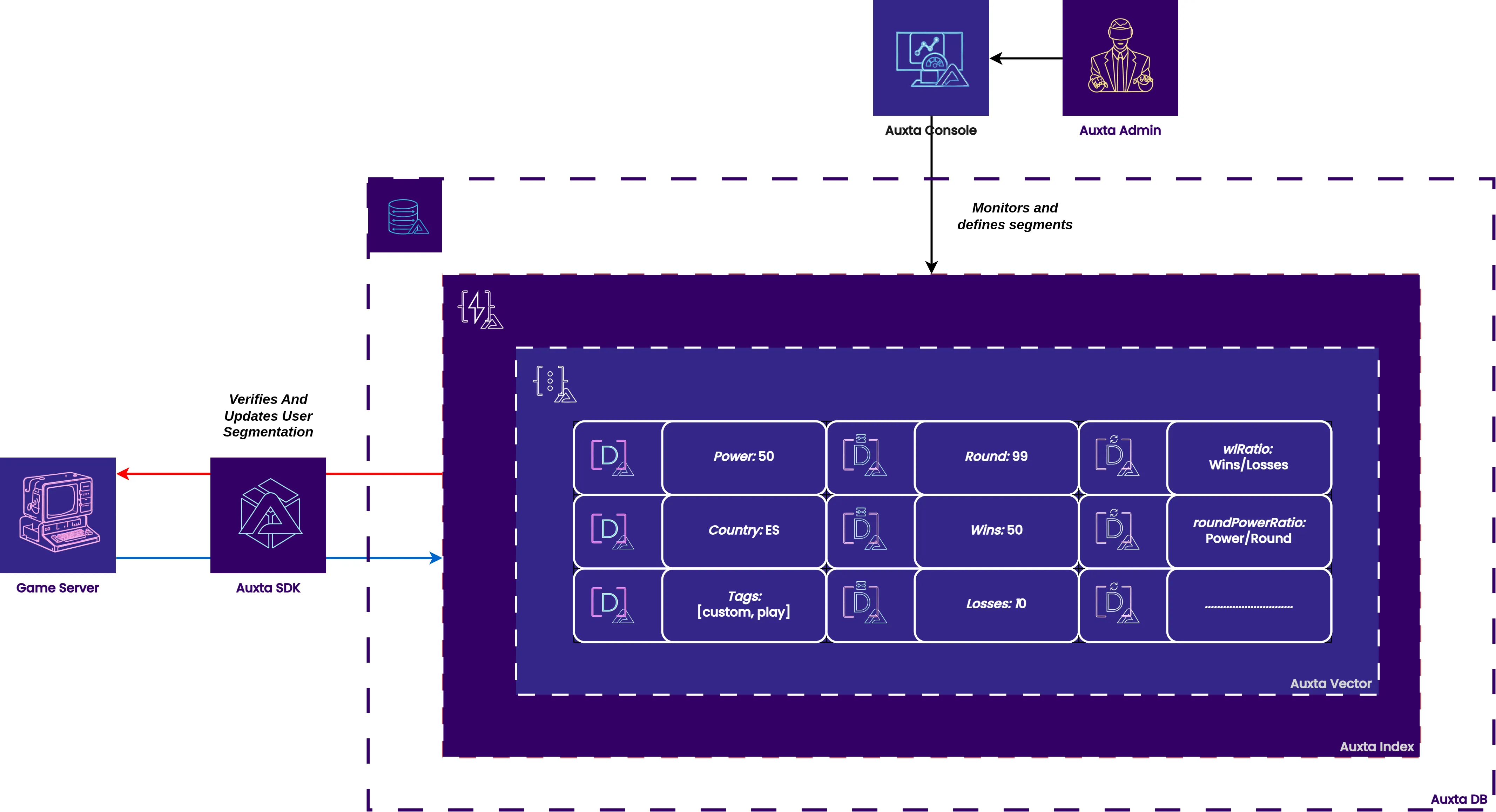
- Auxta ships as a standalone integration — it stores only the behavioral parameters you choose, runs in your environment, and provides a UI for segment definition, real-time monitoring, and live fine-tuning.
The Revenue Problem Nobody Is Measuring Correctly
Ask any LiveOps manager or Head of Growth at a mid-to-large mobile game studio how their segmentation works, and you'll hear a version of the same answer: whales, dolphins, minnows; D1/D7/D30 cohorts; maybe a churn-risk flag from an ML model that runs nightly. The segments exist. The dashboards exist. The problem is that none of it is fast enough, specific enough, or connected directly enough to the decisions that drive revenue in the session window that actually matters.
The financial consequence is structural and consistent. High-value players are under-monetized because the offer engine doesn't know — at the moment they open the shop — that this specific player has a 14-day streak, just completed a hard level, has spent above median in the last 7 days, and is playing at 11pm on a weekend. It knows they're a "whale." That's not the same thing, and the difference in offer relevance is measurable in conversion rate.
Low-value players are over-incentivized because without high-resolution classification, broad retention campaigns apply the same bonus mechanics to players who would have returned anyway, players who are already churned in everything but account status, and players whose behavioral pattern marks them as permanently low-spend regardless of incentive. The bonus budget burns. The ARPU doesn't move.
Retention strategies underperform because they fire on schedule rather than on signal. A push notification sent 24 hours after last session based on a daily batch job is categorically different from a re-engagement trigger fired the moment a player's behavioral vector crosses a churn-probability threshold — while there is still a session window to recover within.
The aggregate revenue impact of these three dynamics, across a live game with meaningful DAU, typically sits between 10 and 30 percent of addressable revenue. Not as a theoretical ceiling — as a measured gap between what current segmentation-driven decisions produce and what the same player base would generate under correctly timed, correctly targeted classification.
Why Static Segments and Rule-Based Logic Always Fall Short
The gaming industry has been aware of segmentation as a lever for over a decade. The reason the revenue gap persists isn't ignorance — it's that the technical approaches most studios rely on have fundamental limitations that no amount of dashboard iteration can fix.
The Coarseness Problem
A segment called "whale" is doing enormous analytical work while providing almost no actionable signal. Two players can both qualify as whales — lifetime spend above a threshold, session frequency above average — while having completely different behavioral profiles. One plays competitively, peaks on weekday evenings, responds to tournament entry offers, and churns when progression walls appear. The other plays casually on mobile, peaks on weekend afternoons, responds to cosmetic bundles, and churns when session length is forced above 20 minutes. Sending both players the same offer, the same push notification, the same event invitation, is not segmentation. It is expensive guesswork with a label on it.
Three to five segments — regardless of how carefully they are defined — cannot capture the behavioral variance of a live game player base at scale. The math doesn't work. Players don't distribute neatly across a small number of archetypes. They distribute across a continuous multi-dimensional behavior space, and the monetization signal lives in that space, not in the coarse buckets drawn around it.
The Latency Problem
Rule-based segmentation — "if rounds played > 50 AND last deposit > 7 days AND session count this week < 3, move to at-risk segment" — is not inherently wrong as a logic model. The problem is when it runs. Batch pipelines that execute daily or even hourly are operating on a fundamentally different time scale than the player's decision window. By the time a player has been reclassified as at-risk by the nightly job, they may have already made the decision to stop playing. The trigger has fired into the past.
In live games, the monetization moment and the churn signal are both session-level events. Classification that doesn't operate within the session is not classification for the purpose of live operations — it is reporting dressed up as decisioning.
The Fragmentation Problem
In most gaming stacks, the data that would enable accurate player classification sits in three or four separate systems: the analytics pipeline has behavioral events, the CRM has marketing interaction history, the payment system has transaction records, and the game server has session state. None of these systems were designed to produce a unified, real-time player representation. Joining them at query time is too slow for in-session decisions. Building an ETL pipeline to synchronize them is expensive, brittle, and still batch-oriented.
The result is that LiveOps decisions are made on partial information — usually whichever data source is most convenient — and the full behavioral picture that would enable precise targeting is never actually assembled.
The Auxta Approach: Players as Behavioral Vectors
Auxta DB is a matchmaking engine built around a single architectural premise: every player in your game can be represented as a multi-dimensional behavioral vector, and classification — the act of determining which segment a player belongs to, in real time, during an active session — should be a query operation measured in fractions of a millisecond, not a batch job measured in hours.
A player vector in Auxta is not a fixed schema. It is a structured representation of every behavioral parameter your game considers relevant — and that list can include anything: static attributes like country and acquisition source, slowly-changing attributes like total spend and total rounds played, rapidly-changing computed attributes like session win rate, last in-game action, consecutive loss streak, current level, active power-ups, and time since last purchase. Auxta maintains all of these dimensions simultaneously, and each one is live — computed and updated in real time as gameplay events occur, not recalculated on the next batch run.
A representative player vector in a mobile game context might include parameters
such as: country, region,
acquisitionSource, totalSpend,
totalRounds, lastLoginTimestamp,
sessionFrequency7d, averageSessionLength,
winRateLast10Sessions, consecutiveLosses,
lastPurchasedItem, preferredGameMode,
currentLevel, lastInGameAction,
churnRiskScore, ltpPredicted — and dozens more
depending on game genre and LiveOps strategy. Auxta supports 100+ dimensions per
vector with no performance degradation at query time.
The critical performance property is the classification query time: under 0.2 milliseconds. This is not a batch classification result cached from an earlier run. It is a live query against the current state of the player vector, resolved within the active request cycle, fast enough to be embedded in the game server's session handling logic without adding perceptible latency to the player experience.
What Real-Time Classification Looks Like in Practice
The Auxta query API is designed around a typed vector model — player behavioral profiles are defined as strongly-typed vector classes, and queries are composed fluently against those types. This matters for live games because it means classification logic is explicit, auditable, and directly connected to the dimensional model, rather than buried in SQL queries or undocumented ML feature pipelines.
Consider a player vector definition for a mobile game that captures both static identity data and live computed behavioral dimensions:
// PlayerVector.ts — defines the full behavioral profile for a player.
// Static fields (country, acquisitionSource) are set on registration.
// Computed fields (totalRounds, winRateLast10, consecutiveLosses, etc.)
// are updated by the game server on every session event — no batch job required.

class PlayerVector extends AuxtaVector {
    country: string;
    region: string;
    acquisitionSource: string;       // 'organic' | 'paid_ua' | 'influencer' | ...

    totalSpend: number;              // lifetime, updated on every purchase event
    totalRounds: number;             // lifetime, incremented per round completion
    lastLoginTimestamp: number;      // unix ms, updated on every session open
    sessionFrequency7d: number;      // computed: sessions in rolling 7-day window
    averageSessionLength: number;    // computed: minutes, rolling 30-day average

    winRateLast10: number;           // computed: 0.0–1.0, last 10 sessions
    consecutiveLosses: number;       // live: resets on win, increments on loss
    currentLevel: number;            // live: updated on level completion event
    lastInGameAction: string;        // live: 'shop_open' | 'level_fail' | 'ad_watch' | ...

    preferredGameMode: string[];     // computed: top modes by session share last 14d
    lastPurchasedItemCategory: string; // 'booster' | 'cosmetic' | 'currency_pack' | ...
    daysSinceLastPurchase: number;   // computed: updated daily from purchase events

    churnRiskScore: number;          // 0.0–1.0, recomputed on each session close
    predictedLTV: number;            // model output, refreshed weekly
}
With the vector defined, inserting or updating a player profile is a single typed operation. The same command interface handles both — Auxta upserts on the vector's identity, so game servers can push behavioral updates without managing insert/update logic:
// Called by the game server on session close — updates all live dimensions
// simultaneously. No reindexing. No pipeline delay. The updated vector
// is immediately available for classification queries.

const playerVector = new PlayerVector({
    country: 'DE',
    region: 'EU-West',
    acquisitionSource: 'paid_ua',
    totalSpend: 142.50,
    totalRounds: 387,
    lastLoginTimestamp: Date.now(),
    sessionFrequency7d: 6,
    averageSessionLength: 18,
    winRateLast10: 0.4,
    consecutiveLosses: 3,
    currentLevel: 52,
    lastInGameAction: 'level_fail',
    preferredGameMode: ['pvp', 'ranked'],
    lastPurchasedItemCategory: 'booster',
    daysSinceLastPurchase: 2,
    churnRiskScore: 0.61,
    predictedLTV: 280,
});

const updateCommand = new AuxtaCommand().add(playerVector);
await auxta.query(updateCommand);
// Player is now classified and queryable across all 100+ dimensions
// with zero propagation delay to segment membership.
The segment query is where the performance advantage becomes tangible. Instead of joining tables or waiting for a batch job, the game server issues a typed search query against the live vector store during the active session — for example, to identify players eligible for a loss-streak recovery offer at the moment of their third consecutive loss:
// Fired in real time when the game server records consecutiveLosses === 3.
// Resolves in under 0.2ms. Result drives immediate offer injection
// into the post-round screen — no async pipeline, no delayed push.

const recoveryOfferSegment = new AuxtaCommand()
    .search(PlayerVector)
    .where('consecutiveLosses', losses => losses.gte(3))
    .where('daysSinceLastPurchase', days => days.gte(3).and().lte(14))
    .where('lastInGameAction', action => action.match('level_fail'))
    .where('churnRiskScore', risk => risk.gte(0.5).and().lte(0.8))
    .where('preferredGameMode', mode => mode.in(['pvp', 'ranked']));

const eligiblePlayers = await auxta.query<PlayerVector>(recoveryOfferSegment);
// Returns only players who are: on a loss streak, recently lapsed in purchasing,
// currently frustrated (last action = level fail), at moderate churn risk,
// AND primarily competitive players — not casual ones who don't respond to this offer type.
Notice what this query does that no rule-based system can: it combines a static dimension (preferredGameMode — a computed preference stable over two weeks), a slowly-changing dimension (daysSinceLastPurchase — meaningful monetization recency), and two live computed dimensions (consecutiveLosses and lastInGameAction — present-tense gameplay state) in a single sub-millisecond operation. The offer fires into the current session, against the current emotional and behavioral state of the player, not into the next morning's push queue.
The same query model handles high-value player identification for premium offer targeting — combining spend history, session frequency, win rate, and acquisition source to surface players whose behavioral profile matches a historically high-conversion segment:
// High-conversion premium offer segment:
// Targets players who are high-spend, highly active, winning consistently,
// and acquired through channels that historically produce high-LTV cohorts.
// Fired when the shop screen opens — resolves before the UI renders.

const premiumOfferSegment = new AuxtaCommand()
    .search(PlayerVector)
    .where('totalSpend', spend => spend.gte(50))
    .where('sessionFrequency7d', freq => freq.gte(5))
    .where('winRateLast10', rate => rate.gte(0.6))
    .where('daysSinceLastPurchase', days => days.gte(5))
    .where('acquisitionSource', src => src.in(['organic', 'influencer']))
    .where('lastPurchasedItemCategory', cat =>
        cat.match('booster').or().match('currency_pack')
    );

const premiumPlayers = await auxta.query<PlayerVector>(premiumOfferSegment);
// These players are: established spenders, highly engaged this week,
// on a winning streak (high satisfaction), purchase-lapsed enough to be receptive,
// from high-quality acquisition sources, and have a purchase history in high-margin categories.
This is the operational difference between three segments and dozens of micro-segments: not just more buckets, but more precise intersection of conditions that actually predict conversion — assembled at query time from live data, not pre-computed overnight.
The Reindexing Problem — and Why It Matters More Than It Sounds
There is a technical constraint that makes traditional databases and even most purpose-built analytics stores unsuitable for live game segmentation at scale: reindexing. When you add a new behavioral parameter — a new game mode is launched, a new economy mechanic is introduced, a new event type becomes relevant for segmentation — any column-store or document database with a fixed index structure requires a reindex operation to support queries against that new dimension.
In a live game with millions of player records, a reindex can take hours. During that window, queries against the new dimension are either unavailable or degraded. For a seasonal event launch where the new mechanic is the entire basis of the LiveOps campaign, this is not a minor inconvenience — it is a hard operational constraint that forces teams to either plan campaigns around their database's maintenance schedule or accept degraded targeting at launch.
Auxta's vector model eliminates this constraint entirely. Because player data is stored as dimensional vectors rather than rows with fixed column indexes, adding a new parameter to the vector definition requires no reindexing operation. The new dimension is available for queries immediately after the first player vector is written with it populated. Existing players without the new parameter are simply unmatched on that dimension — they don't error, they don't degrade query performance, and they don't require a migration job to handle.
For game teams running content updates on two-week or four-week cycles, this is a meaningful operational advantage. Segmentation logic can evolve at the same pace as the game itself — not at the pace of the infrastructure team's maintenance windows.
Integration Model: Standalone, Controlled, Immediately Operational
Auxta is designed to integrate into an existing gaming stack without requiring a data platform overhaul. It operates as a standalone service that stores only the behavioral parameters you explicitly define in your vector schema — it does not replicate your full player database, does not require access to your analytics pipeline, and does not replace your existing CRM or BI tooling.
The integration points are narrow by design: the game server writes player vector updates to Auxta on session events (session open, round complete, purchase, session close), and the offer engine or LiveOps platform queries Auxta for segment membership when a decisioning moment occurs (shop open, post-round screen, push notification trigger, event eligibility check). Everything between those two integration points is handled by Auxta — the vector storage, the dimensional indexing, the query resolution, and the segment matching.
The Auxta UI provides LiveOps managers and product teams with direct control over segment definitions without engineering involvement. Segment logic — the dimensional thresholds, the combination operators, the inclusion and exclusion conditions — can be modified in the UI and takes effect on the next query. There is no deployment cycle, no pipeline reconfiguration, no waiting for the next batch run. A campaign manager who identifies that a particular churn-risk threshold is firing too broadly can adjust it in the UI during the live campaign and see the effect on segment population size immediately.
The operational log within the UI surfaces every classification decision made during active sessions — which players matched which segments, which offers were triggered, and which dimensional conditions were decisive in the match. For LiveOps teams performing post-campaign analysis or fine-tuning segment definitions, this decision audit trail replaces the guesswork of inferring why a campaign performed as it did from aggregated metrics.
Translating Classification Precision into Revenue
The 10–30% revenue inefficiency figure cited at the opening of this article is not a theoretical projection — it is a structural consequence of the three gaps that Auxta directly addresses: coarseness, latency, and fragmentation. Closing those gaps produces measurable improvements across the metrics that determine monetization health in live games.
ARPU improves because offer targeting becomes precise enough to match offer type, offer value, and offer timing to the player's current behavioral state — not to a broad archetype defined weeks ago. A high-spend competitive player on a loss streak in the last ten minutes of their session is a different conversion opportunity than a high-spend casual player opening the app for the first time in four days. Treating them as the same "whale" is the source of the inefficiency. Treating them as two distinct behavioral moments is the source of the recovery.
LTV improves because retention triggers fire on behavioral signal rather than schedule. The difference between triggering a re-engagement mechanic when a player's session frequency drops below their personal baseline — detected in real time as the vector updates — versus triggering it 24 hours after last session via a batch job is the difference between intervening while the player still has active intent and intervening into a decision that has already been made.
CAC payback time shortens because UA-to-monetization conversion improves when newly acquired players are classified by behavioral signal from their first sessions — not held in a "new user" segment for 30 days before any targeted intervention occurs. A player acquired via a competitive game ad who demonstrates high session frequency, high win rate, and engagement with ranked modes in their first week is identifiable as a high-LTV acquisition target within days. Auxta's vector model makes that classification available within the first session.
Bonus and promotional spend efficiency improves because the segments driving promotional decisions are precise enough to exclude players whose behavioral profile makes them unlikely to convert regardless of incentive. Bonus waste — spend on players who either would have converted without incentive or who will not convert with it — is a direct function of how accurately you can identify which players sit in between. Micro-segmentation with 100+ behavioral dimensions is how you identify that middle band with enough precision to make the exclusion worthwhile.
Conclusion
Weak player segmentation is not a data problem. Most studios have more behavioral data than they can effectively use. It is a decision-timing problem caused by the absence of real-time behavioral classification — and that is precisely the problem Auxta DB was built to solve.
The combination of a 100+ dimensional vector model, sub-0.2ms classification queries, schema-flexible design with no reindexing on parameter changes, and a LiveOps-accessible UI for real-time segment fine-tuning represents a categorically different capability from what batch pipelines and rule-based CRM logic can provide. The performance delta is not incremental. It is structural — and it compounds over every session, every offer, every retention campaign your game runs.
For studios operating live games at meaningful scale, the question is not whether more precise segmentation would improve revenue outcomes. The data on that is clear. The question is whether your current stack can deliver classification at the speed and resolution the opportunity requires. If it cannot, the 10–30% gap stays open — and it stays open on every player, in every session, every day the game runs.
Auxta DB is available for integration evaluation with existing gaming stacks. The ADAAS team runs scoped technical assessments to determine fit and estimate deployment timeline — typically two weeks from integration kickoff to live classification in production.
Thinking About AI SDLC for Your Team?
Whether you're evaluating A-Concept for a new project or looking to introduce AI-assisted delivery into an existing team, our engineers can walk through the architectural tradeoffs with you. Book a technical session or reach out below.